The Quiet Takeover of the Digital Commons
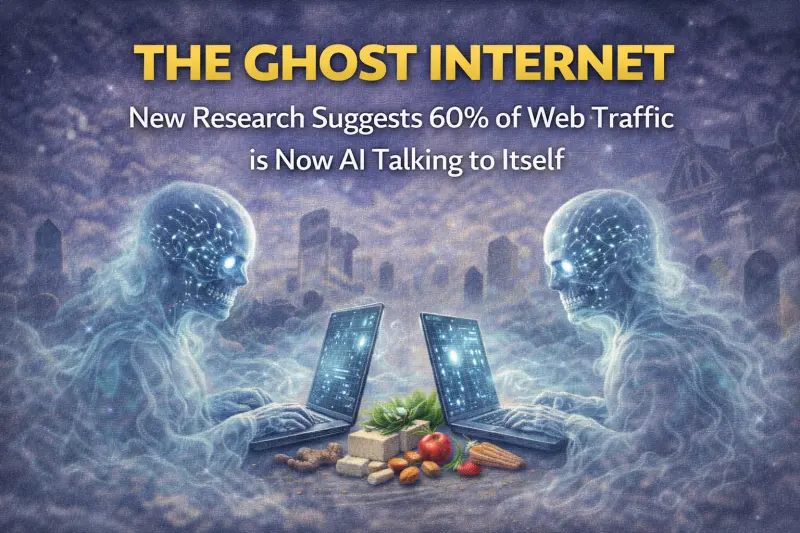
Walk through the digital streets of today’s internet and you might feel a lingering sense of déjà vu. A comment on a social media post sounds strangely familiar; a product review feels a bit too polished; a news summary reads with a peculiar, rhythmic neutrality. It turns out that this isn't just a trick of the mind. New research into global data flows suggests we have passed a definitive tipping point: 60% of all internet traffic is now generated by artificial intelligence talking to other artificial intelligence.
For decades, the internet was envisioned as a global town square—a place for human-to-human connection, debate, and creativity. But the latest metrics suggest that this town square is increasingly populated by ghosts. We are witnessing the birth of the "Ghost Internet," a self-sustaining ecosystem where automated scrapers, large language models (LLMs), and autonomous agents exchange data in a closed loop, often without a single human eye ever seeing the result.
This isn't just about simple bots performing repetitive tasks. We are seeing a sophisticated shift in how information is consumed and produced. As companies deploy AI to monitor competitors, optimize search rankings, and generate content at scale, the biological user is becoming a minority stakeholder in the very network they created.
The Mechanics of the Ghost Internet
To understand how we reached this 60% threshold, one must look at the hidden architecture of the modern web. The vast majority of this non-human traffic falls into three primary categories:
- Scrapers and Harvesters: AI models require massive amounts of data to remain relevant. Thousands of bots are constantly crawling every corner of the web to feed the next generation of LLMs, creating a constant hum of background activity.
- Automated Content Cycles: From programmatic SEO-driven articles to automated financial reports, AI is now writing the content that other AI systems then summarize for executive briefings or news aggregators.
- API Interactions: As businesses integrate AI into their workflows, software is increasingly talking to software. An AI travel assistant might query ten different AI-driven booking platforms, which in turn query various airline databases—a cascade of automated requests triggered by a single human prompt.
The result is a digital environment that is increasingly recursive. When an AI-written blog post is indexed by a bot, summarized by a second AI, and then used as training data for a third, the human element is effectively bypassed. We are no longer just using the internet; we are hosting a massive, high-speed conversation between machines.
The Threat of Model Collapse and the 'Habsburg AI'
The most pressing concern for researchers isn't just the volume of traffic, but the quality of the data being generated. This phenomenon, often referred to as "Model Collapse," occurs when AI models are trained on synthetic data—that is, content generated by other AIs—rather than original human thought. Much like the biological effects of inbreeding, researchers warn of the "Habsburg AI" effect: a digital degeneration where errors, biases, and hallucinations are amplified with every successive generation.
If 60% of the web is already automated, the chance of a new AI model being trained on its own predecessor's output is nearly 100%. Without the unpredictable, messy, and creative input of human beings, these models risk becoming caricatures of themselves, losing the nuance and factual grounding that makes them useful in the first place. The "Ghost Internet" isn't just empty; it's potentially becoming a hall of mirrors where reality is distorted through constant repetition.
The Economic Mirage: Ad Fraud and the Junk Web
This shift also presents a fundamental challenge to the economic foundations of the web. Most of the free internet is funded by advertising, a system built on the assumption that a human being is on the other side of the screen. When a significant portion of traffic is AI interacting with AI, the metrics that define value—clicks, impressions, and dwell time—become meaningless.
Advertisers are beginning to wake up to a reality where they are paying to show ads to bots that are programmed to click them, on websites written by bots to attract those very scrapers. This "junk web" creates an economic mirage, where numbers go up while actual human engagement plateaus or declines. For the average user, this means the "real" web is becoming harder to find, buried under mountains of algorithmically optimized fluff designed to capture machine attention rather than provide human value.
The Human Retreat to 'Dark Social'
As the public web becomes increasingly saturated with synthetic noise, we are seeing a fascinating counter-movement: the human retreat. People are moving away from open platforms like X (formerly Twitter) and public forums, migrating instead to "dark social"—private, gated communities like Discord, Signal groups, and invite-only Slack channels.
In these walled gardens, users find something the Ghost Internet cannot yet replicate: authentic, unoptimized human connection. The value of a "biological" recommendation—a friend telling you about a book or a colleague sharing a niche insight—has never been higher. This suggests that while AI may dominate the traffic charts, the *influence* remains firmly in the hands of those who can prove they are made of carbon rather than code.
Searching for the 'Human Proof'
The rise of the Ghost Internet is forcing a re-evaluation of digital trust. We are entering an era where "human-grade" content will likely carry a premium. We may soon see the widespread adoption of digital watermarking and provenance protocols, like the C2PA standard, designed to verify that a piece of media or text originated from a human creator.
The challenge for the next decade will be maintaining a space for human spontaneity in an environment optimized for machine efficiency. If the trend continues, the open web may serve primarily as a data-exchange layer for automated agents, while human culture flourishes in more private, verified niches. The internet isn't dying, but it is certainly changing its shape, evolving into a landscape where we are no longer the primary residents, but merely the architects of a world that has begun to move on without us.