The Great Shift: From Links to Answers
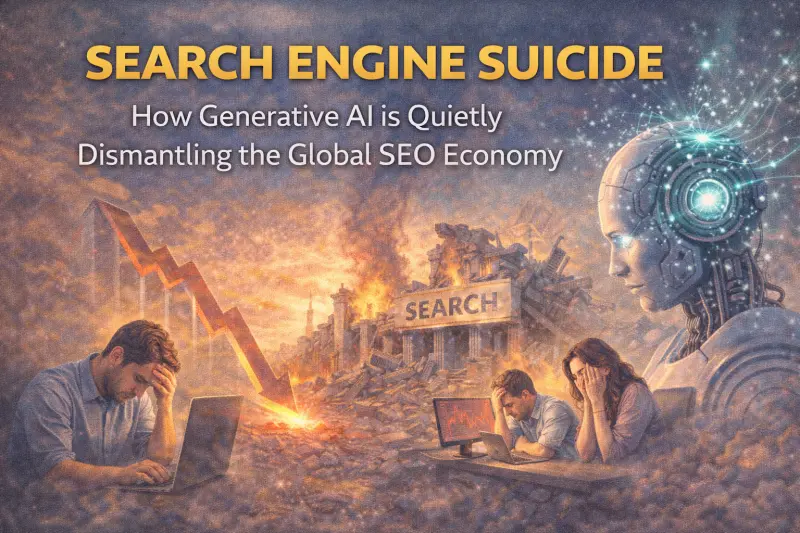
For over two decades, the global digital economy has been built on a simple, unspoken contract: search engines provide a gateway to information, and in exchange, content creators receive traffic. This traffic is the lifeblood of the Search Engine Optimization (SEO) industry, a sector worth tens of billions of dollars. However, the emergence of Generative AI is effectively tearing up this contract. By providing direct, comprehensive answers within the search interface, platforms are keeping users within their own ecosystems, leading to what experts are calling 'Search Engine Suicide.'
As Google integrates its Search Generative Experience (SGE) and Perplexity gains market share, the traditional 'ten blue links' are being pushed further down the page—or off it entirely. This transition from a search engine to an 'answer engine' marks a seismic shift in technology and digital marketing, threatening the visibility of millions of websites that rely on organic search for survival.
The Zero-Click Reality and the Death of Referral Traffic
The primary weapon in this dismantling of the SEO economy is the 'Zero-Click' search. A zero-click search occurs when a user's query is satisfied directly on the search results page without them needing to click on any website. According to recent industry data, more than 60% of mobile searches now end without a click. Generative AI is poised to accelerate this trend dramatically.
When an AI summarizes a complex recipe, explains a legal concept, or provides a technical tutorial, the original source of that information—the blog, the news site, or the niche forum—loses the visit. This creates a parasitic relationship where Large Language Models (LLMs) are trained on the high-quality data produced by human creators, only to then use that data to bypass the creators' websites. Without traffic, the monetization models of these sites—be it through advertising, affiliate links, or subscriptions—collapse, leading to a massive contraction in the global digital content economy.
The Pivot to AEO: Answer Engine Optimization
As traditional SEO tactics lose their efficacy, a new discipline is emerging: Answer Engine Optimization (AEO). Digital marketers are no longer just trying to rank for specific keywords; they are now struggling to ensure their content is cited by the AI as a primary source. This requires a fundamental shift in strategy. Instead of focusing on keyword density, marketers must focus on 'entity-based' optimization and providing structured data that AI models can easily ingest.
However, AEO presents a double-edged sword. While being a cited source provides brand authority, it rarely translates to the same volume of traffic that a top organic ranking once did. Digital marketing agencies are currently scrambling to redefine their value propositions as their clients' organic reach continues to dwindle. The industry is moving toward a 'brand-first' approach, where the goal is to build such a strong reputation that users seek out the brand directly, bypassing the AI gatekeepers altogether.
The Feedback Loop and the 'Dead Internet' Risk
One of the most alarming consequences of the AI-driven SEO decline is the potential for a digital 'feedback loop.' As human-led publishers find it less profitable to create high-quality, original content, the web risks being flooded with cheap, AI-generated filler. This leads to a degradation of the very data that future AI models need to learn from. This phenomenon, often referred to as the 'Dead Internet Theory,' suggests a future where the web is populated largely by bots creating content for other bots to index.
For the global economy, this means a potential drop in the quality of information available to consumers. From a business perspective, the barriers to entry for new websites have never been higher. Established brands with deep archives of data have a massive advantage, while independent creators find themselves locked out of the visibility loop by algorithms that favor their own synthesized summaries over external perspectives.
Conclusion: Survival in the Post-SEO Era
The dismantling of the traditional SEO economy is not just a trend; it is a structural transformation of the internet. While search engines are not disappearing, their role as a bridge between users and creators is being fundamentally rewritten. To survive, businesses must diversify their traffic sources, moving beyond a total reliance on Google. Strategies involving email marketing, community building, and high-value video content are becoming essential for resilience.
Ultimately, the 'Search Engine Suicide' we are witnessing is the birth of a new era of information retrieval. While the loss of the traditional SEO model is disruptive and financially painful for many, it forces a return to quality over quantity. In a world where AI can generate infinite content, the value of human expertise, unique insights, and authentic brand voices will become the only true currency that an algorithm cannot fully replicate.