The Long, Strange Trip That Never Quite Ends
There is a specific kind of magic—or perhaps a specific kind of madness—found in the parking lots of amphitheaters across America when the Grateful Dead’s various incarnations roll into town. It is a world of patchouli, grilled cheese sandwiches sold for 'miracle' tickets, and a communal devotion that defies the standard laws of modern fandom. The new documentary Summer Tour, recently reviewed by Variety, seeks to bottle this lightning. However, instead of offering a detached sociological study, the film chooses to dive headfirst into the tie-dyed deep end, resulting in a viewing experience that is as blissed-out and navel-gazing as the subculture it chronicles.
For the uninitiated, the term 'navel-gazing' might carry a sting of criticism. In the context of Summer Tour, it functions more as a stylistic choice. The filmmakers aren’t particularly interested in explaining why the music matters to the world at large or tracing a chronological history of the band’s evolution. Instead, the documentary operates on 'Dead time'—a languid, wandering pace that prioritizes atmosphere over narrative efficiency. It is a film that demands you turn off your internal clock and simply drift along with the rhythm of the road.
A Cinematic Mirror of Shakedown Street
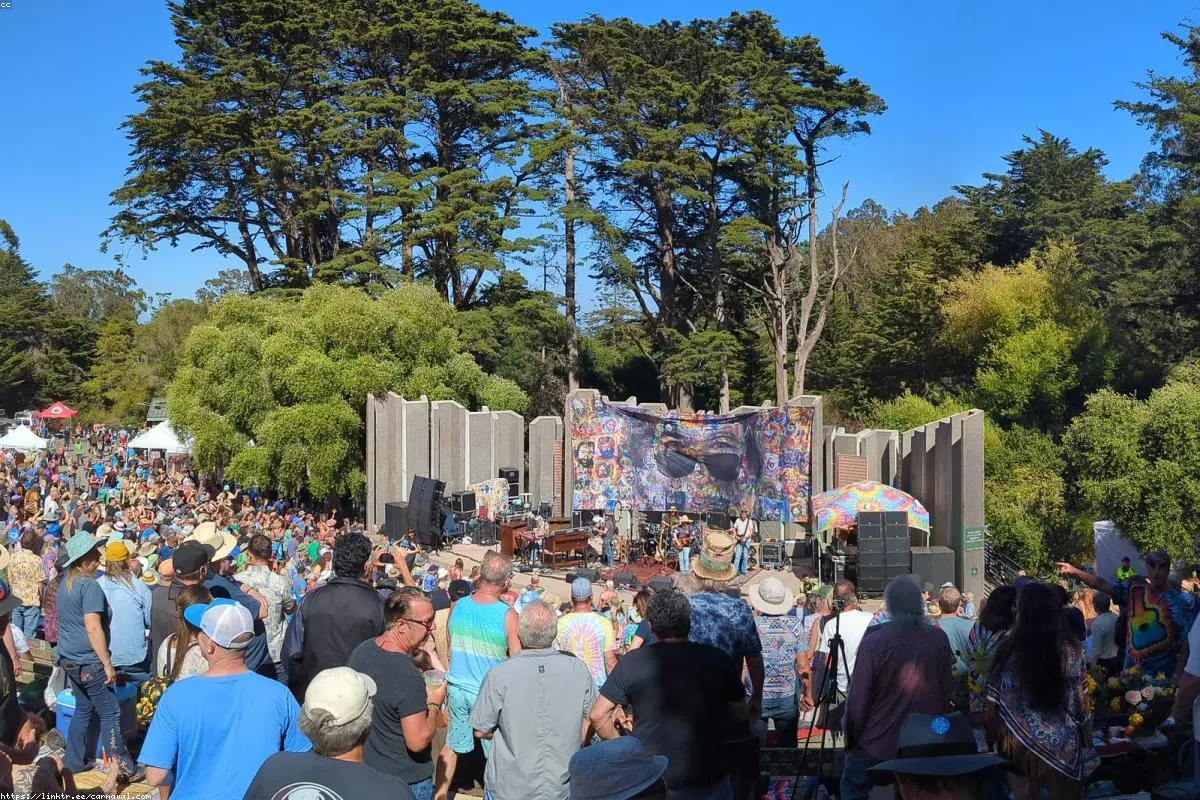
Much of the film’s runtime is spent in the 'Shakedown Street' vending areas, capturing the kinetic energy of the pre-show ritual. We meet a colorful cast of characters, ranging from the 'Grey-hairs' who saw Jerry Garcia in '72 to the 'Tour Brats' who are experiencing their first summer on the road. The cinematography is intentionally hazy, often using soft focus and saturated colors to mimic the psychedelic experience. It’s an immersive approach that makes the viewer feel less like an observer and more like a participant in the drum circle.
This immersive quality is a growing trend within the broader entertainment landscape, where documentaries are moving away from the 'talking head' format toward something more experiential. Summer Tour doesn't care if you don't know the difference between a 'Dark Star' and a 'Sugar Magnolia.' It assumes you are already part of the family, or at the very least, willing to be adopted for ninety minutes. While this makes for a deeply nostalgic trip for the faithful, it occasionally leaves the casual viewer searching for a more grounded perspective.
The Beauty of the Insular
The film’s greatest strength—and perhaps its most polarizing feature—is its refusal to offer a critical counter-narrative. There are no musicologists here to deconstruct the technicality of the jams, and no cynical outsiders to mock the spinning dancers. By staying strictly within the bubble, Summer Tour captures the genuine sincerity of the Deadhead community. In an era often defined by irony and digital detachment, the earnestness on display is almost radical. The subjects speak of 'energy,' 'connection,' and 'the vibe' with a lack of self-consciousness that is both beautiful and, at times, unintentionally funny.
However, by being so blissed-out, the documentary does gloss over some of the grit. The logistical nightmares of life on the road, the financial precarity of the nomadic lifestyle, and the inevitable comedowns are treated as mere footnotes to the transcendental musical moments. It’s a sanitized version of the trip—one that emphasizes the peaks while ignoring the valleys. This choice reinforces the 'navel-gazing' critique; the film is so enamored with the reflection of its subjects that it forgets to look at the shadows they cast.
A Niche Masterpiece or a Private Joke?
Ultimately, Summer Tour serves as a high-quality artifact for a very specific tribe. It succeeds in capturing the sensory details of the scene: the way the light hits the stage during a second-set jam, the dusty heat of a July afternoon in a concrete parking lot, and the collective gasp of a crowd when a rare song is teased. It is a technical achievement in mood-setting, even if its intellectual depth is somewhat shallow.
As the credits roll over a slow-motion montage of smiling faces and spinning tie-dye, it’s clear that the film has achieved its goal. It doesn't want to explain the Grateful Dead; it wants to let you feel what it’s like to live within the music. For those who have spent their summers chasing the band from city to city, Summer Tour will feel like a warm embrace. For everyone else, it remains a fascinating, if slightly confusing, glimpse into a world that refuses to stop dancing, no matter how much the rest of the world changes around it.
In the crowded field of music documentaries, this film stands out by being unapologetically itself. It is a reminder that sometimes, the most honest way to document a subculture is to adopt its own perspective, even if that perspective is a bit blurry around the edges.