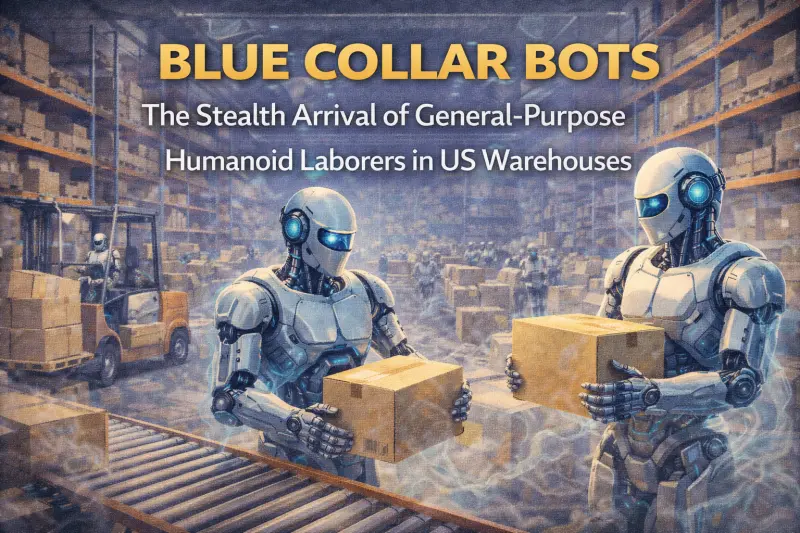
The Quiet Hum of a New Workforce
Walk into a typical logistics hub in the American Midwest today, and you might notice a shift in the atmosphere. The frantic pace remains, but the silhouette of the workforce is changing. For decades, warehouse automation meant massive, bolted-down robotic arms or orange Roombas-on-steroids zipping across floor grids. But lately, a more familiar shape has begun appearing in the aisles: the humanoid. These machines, equipped with two legs, two arms, and a head full of sensors, aren't just props for a sci-fi film. They are the first wave of a general-purpose robotic labor force quietly clocking into the world of blue-collar work.
This isn't a sudden, flashy takeover. It is a stealthy integration. Companies like Figure AI, Agility Robotics, and Apptronik are deploying their bipedal workers in pilot programs across the United States. Unlike their predecessors, these robots aren't built for a single, repetitive task like welding or tape-sealing. They are designed to do whatever a human can: walk up stairs, reach for high shelves, and pivot in tight spaces. They are being built to fit a world that was designed by humans, for humans.
The Architecture of Adaptability
For a long time, the prevailing wisdom in robotics was that humanoids were inefficient. If you want a robot to move boxes, why give it two legs that can trip? Why not wheels and a forklift attachment? The answer lies in the concept of "brownfield" environments. Most of the world’s infrastructure—warehouses, loading docks, and narrow mezzanines—was built with the human gait and reach in mind. To automate these spaces with traditional robotics, companies often have to spend millions of dollars retrofitting their facilities. Humanoid robots offer a shortcut: they can work in the building you already own, using the tools you already have.
Take Digit, the bipedal robot developed by Agility Robotics. Digit doesn't look like a human in a costume; its legs have a bird-like backward bend that allows it to crouch and lift with incredible stability. In Amazon’s testing facilities, Digit is tasked with the "recirculation" of empty totes—a tedious, physically demanding job that humans find draining. By taking over these repetitive tasks, the humanoid allows human workers to focus on more complex problem-solving. It’s a symbiotic relationship that shifts the robot from being a specialized tool to a general-purpose teammate.
The Brains Behind the Brawn
What has changed in the last 24 months isn't just the hardware, but the intelligence driving it. Large Language Models (LLMs) and advanced computer vision are being integrated into these robotic frames. This means that instead of a technician writing thousands of lines of code to teach a robot how to pick up a specific box, the robot can now learn through observation or simple verbal instructions. When a robot like Figure 01 works in a BMW manufacturing plant, it uses neural networks to understand the difference between a crate of parts and a piece of trash, adapting its grip and posture in real-time.
The Economic Engine of Automation
The push for humanoid laborers isn't just about the love of technology; it’s driven by a massive labor gap. The American logistics industry is facing a chronic shortage of workers. As e-commerce continues to swallow retail, the demand for warehouse labor has outpaced the available workforce. Turnover in these roles can often exceed 100% annually, as the physical toll of the work leads to burnout and injury.
Humanoid robots offer a compelling economic solution through the "Robotics-as-a-Service" (RaaS) model. Instead of a warehouse manager buying twenty robots for $2 million upfront, they can essentially "rent" the robots at an hourly rate that competes with or even beats human wages. This lowers the barrier to entry and allows smaller companies to scale their operations without needing a massive capital expenditure. More importantly, these robots don't get tired, they don't file workers' compensation claims for back strain, and they can work through the night with the lights turned off.
The Human Element: Evolution or Replacement?
The arrival of blue-collar bots naturally raises the question of what happens to the human laborers they are mimicking. History shows that automation tends to shift the nature of work rather than eliminate it entirely, but the humanoid revolution feels different because of its versatility. When a machine can perform any physical task a human can, the "safe" zones for human employment begin to shrink.
However, industry experts suggest a more nuanced outcome. We are likely entering an era of "augmented labor." In this scenario, the humanoid handles the "dull, dirty, and dangerous" tasks—the 3 Ds of robotics—while humans move into supervisory roles. A warehouse worker might transition from being a box-mover to a fleet manager, overseeing a dozen robots and intervening only when the AI encounters a problem it can't solve. The challenge for society will be the speed of this transition; if the technology scales faster than our ability to retrain workers, the economic friction could be significant.
The Roadmap Ahead
We are currently in the "pilot phase" of this revolution. You won't see a humanoid in every grocery store or local shipping center just yet. The primary hurdles remain battery life—most bots can only work for 2 to 4 hours before needing a charge—and the refinement of fine motor skills, like handling fragile objects or untying knots. But these are engineering problems with visible solutions.
As these machines become more robust and their AI brains more capable, the sight of a bipedal robot unloading a truck at 3:00 AM will become as mundane as seeing a self-checkout machine at the supermarket. The stealth arrival is over; the era of general-purpose labor has begun. The warehouses of the US are merely the testing ground for a technology that will eventually move into construction, healthcare, and perhaps, eventually, our homes.